Friday, September 23, 2011

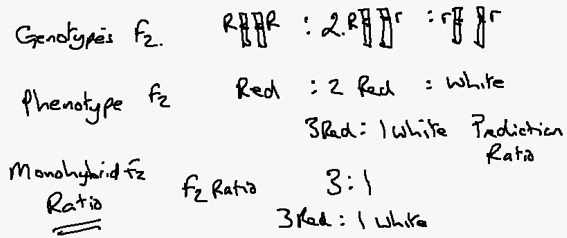
3.19 b) F1 x F1 Cross


3.19) Describe pattern of monohybrid inheritance using a genetic diagram
F1 = First Generation


3.19a) P1 x P1 Cross

3.19) Describe pattern of monohybrid inheritance using a genetic diagram
P = parents


3.18) Phenotype and Genotype

3.18) Recall the meaning of the terms: dominant, recessive, homozygous, heterozygous, phenotype, genotype and codominance


Phenotype


Genotype


Thursday, September 15, 2011

3.2) Fertilization


Understand that fertilization involves the fusion of a male and female gamete to produce a zygote that undergoes cell division and develops into an embryo

The process of fertilization begins with the adults male and female.
The cells in testis and ovaries both have complete set of chromosomes (called diploid, or 2n), meaning both have 46 chromosomes each.
Theses cells divide to form cells with half set of chromosome (23 each) in the process called meiosis. We go from a diploid number to a haploid number, n
This leaves us with 23 chromosomes in each sperm and egg cell.
In sexual reproduction, these two cells are brought together and are joined/fused to form just one cell. This process is known as fertilization. It involved a combining of half set and half set of chromosomes to form a full set of chromosome.
n + n = 2n
This cell is called zygote, which is combination of male and female chromosomes. 
The zygote then go through a process called mitosis in which the cell will divide to give two cells (in which both contains complete set of chromosome). As a result, all cells contain 2n/diploid number of chromosome. 
When we have sufficient cells, the structure would be called an embryo. 
Such process holds through for all sexually reproducing organisms. 


3.9 b) Female Reproductive System


Recall the structure and function of the male and female reproductive systems


Before the pregnancy occur, the size of the uterus is no larger than an orange.

Structure & Function
Ovary - where meiosis occurs; production of eggs
Oviducts (fallopian tube) - carry the eggs to the uterus and where fertilization takes place
Uterus - structure in the center (womb) 
a) wall of uterus - made of muscle that stretch to accommodate a pregnancy
b) lining of uterus - accepts and develops the fertilizing eggs which will develop into the embryo and the child, as well as the development of the placenta
Uterus space - where the sperm cells and eggs cells moves … where embryo developed into unborn child
Cervix - entrance of sperm cells to the uterus 
Vagina - (where the penis is introduced at the end and the sperm cells enters the uterus)
collects sperm cells and travel them into the uterus


3.9 a) Male Reproductive System


Recall the structure and function of the male and female reproductive systems


Structures & Functions
Bladder - store urine
Testis - carry out process of meiosis that produce that gamete called sperm cells
Epididymis - tube system that store sperm cells
Vas deferens - carry sperm cells to penis during sexual stimulation

Sperm cells travel through...
Prostate - produce 20-30% of the volume of semen which contains sugars and is alkali (to neutralize the acidic secretion within the vagina)
Seminal Vesicles - produce sugar base and alkali secretion (70% of the semen in which the sperm cells can travel)

Sperm + Seminal Vesicles + Prostate ----> Semen (male reproductive fluid)

Semen travels down the...
Urethra - common tube which joins the left and right testis and the left and right vas deferens that takes semen down the penis, as well as the urine

Penis - carry sperm cells into the vagina during sexual intercourse


Thursday, September 8, 2011

3.12) Amniotic fluid

3.12) Amniotic Fluid
Understand how the developing embryo is protected by amniotic fluid

Inside the uterus space surrounding the embryo is a fluid called amniotic fluid
The function of the amniotic fluid is to protect the developing embryo. The fluid is largely water. As a result, it cannot be compress. If any blows force is applied to the outside of uterus wall, it absorbs the pressure, preventing damage to unborn child.