Showing posts with label Coordination and Response. Show all posts

Sunday, February 5, 2012

2.89 Hormones


Understand the sources, roles and effects of the following hormones: ADH, adrenaline, insulin, testosterone, progesterone and oestrogen. 
Hormones are made in endocrine glands and are chemical messengers which travels in through blood in the plasma. (Because endocrine glands do not have ducts which carry hormones to target organs).


Adrenaline
Source: adrenal glands
Target: (many organs) e.g.) Heart
Excitement, anger, fright or stress 
Prep"Flight or fight" (attack or run for your life!)

Effects: 
- increased heart rate
- increased depth of breathing and breathing rate
- increased sweating
- hair standing on end (goose bumps)
- dilated (wider) pupils
- pallidness = blood is redirected to muscles

ADH - anti-diuretic hormones
Source: pituitary gland (in the brain)
Target: Collecting duct (of kidney tubules)
Controls amount of water to be reabsorbed into the blood in the kidney tubules (collecting duct) 

Insulin
Source: Pancreas
Target: Liver
Effect: Storage of glucose --> reduce blood sugar level 
Controls glucose level in the blood and keep it steady to prevent illness

Insulin is released after a meal (because glucose level rises after meal) to convert glucose into glycogen for storage and is insoluble. 


Glucagon
Source: Pancreas
Target: Liver
Effect: Break glycogen down into glucose in the liver 

Testosterone (male only)
Source: Testes
Target: (many organs) e.g.) Testis
For secondary growth and sexual characteristics in boys

Progesterone (female only)
Source: Ovaries
Target organ: Uterus Lining
Prevent the uterus lining from breaking down so that fertilized egg can plant into endometrium. (Maintain the lining of uterus.) If no sperm is present then ovaries stop producing progesterone and endometrium wall breaks down, resulting in menstrual bleeding.

Oestrogen (female only)
Source: Ovaries
Target: Uterus Lining
Effect: Buildup to the thickness of the uterus lining 
Responsible for secondary sexual characteristics 
Work with progesterone for menstrual cycle; Produce LH hormone that causes ovary to release its egg (ovulation


Difference between nerves and hormones:
- Hormones can have different effects

2.88 Skin and Temperature Regulation


Describe the role of the skin in temperature regulation, with reference to sweating vasoconstriction and vasodilation


Stimulus: Bood temperature (change in internal temperature)
Receptor: Hypothalamus 
Effector: Skin
Response: Cooling down/ Warming up 


Core temperature is controlled by Hypothalamus. It is a part in the brain that monitors temperature of blood passing through the brain (detects changes in temperature of blood). 
It is also responsible for ADH (osmoregulation).


The keeping of inner conditions within acceptable limits, such as water or temperature, is called homeostasis. 

Skin is responsible for temperature regulation within our body.
The core temperature of our body is 37 C. It is important to maintain our body temperature at about 37 C because enzyme is most efficient at this temperature.

Temperature control is a negative feedback. This means to any change in the environment, the negative feedback system will try to minimize the change as much as possible.
Blood sugar and water level are also controlled by negative feedback system. 


Decreased temperature (too cold) --> trying to warm up
- Vasoconstriction - capillaries narrows, so they carry less blood. This keeps heat inside the body
- Reduce sweating
- Hair erection (goose bumps) - muscles contract to makes hair stand up in order to trap the layer of air to avoid heat from escaping (it is a poor conductor of heat) 
- Shivering - releases extra heat from increased respiration
- Insulation from a layer of fat under the skin

Increased temperature (too hot) --> trying to cool down
- Vasodilation - Capillaries widened so more blood can be carried to the surface. heat transferred out of the body through conduction and radiation.
- Sweating occurs for evaporation as it reduces amount of heat. 
- Hairs lay flat  = less air is trapped so heat can transfer out of surroundings
- No shivering occurs. 


2.87 Eyes' Response to Stimuli


2.87 Understand the function of the eye in focusing near and distant objects, and in responding to changes in light intensity
Focusing Near and Distant Object
Cornea bends light to bring them to a focus on retina. 
Lens sharpen the image and makes it "clear".

For far objects, the rays of light entering the eyes are almost parallel. This means it requires less bending to bring focus on retina.
As a result the ciliary muscle relaxes --> suspensory ligaments pulls the lens to make it thin

For near objects, the rays of light entering the eyes are greatly diverged. Therefore more bending is required for focusing. 
Ciliary muscle then contracts, reducing tension on the lens. The lens then "snap" back into fatter shape, bending light more. 


Changes in light intensity

Iris control the amount of light entering the eyes by changing the size of pupil. 
It contains circular and radial muscles. 

Bright = circular muscles contract, radial muscles relax
This makes pupil smaller and less light can enter the eyes. 
Too much light entering the eyes can do damage.)

Dim = circular muscles relax, radial muscles contract 
This makes pupil bigger and so more light can enter the eyes
This helps us see in darker places (the eyes is trying to collect as many light as possible to see clearly) 


2.86 Eyes

2.86 Describe the structure and function of the eyes as receptor
Eye is the receptor that detects light.
Stimulus : Light
Sense: Sight


Ciliary Muscles - contract or relax to alter shape of the lens (for focusing)
Cornea - allows light in and bends light
Iris - (colored part of the eyes) change pupil size to control the amount of light entering the eyes
Pupil - hole in the centre of the eye in which light enters
Lens - change shape to focus light (of near and far objects)
Vitreous Humour - (transparent, jellylike substance) supports the back of the eyes
Retina - contains receptor cells (nerves) which is concentrated on one part of the eye. It change light into electrical impulse
- Rods - sensitive in dim light (but can't see colors as cones does not work well in dark) 
- Cones - detect colors, work best in bright light
Sclera - Protect the eyes
Suspensory ligaments - hold lens in place as it changes shape (pulls or contract lens in response to ciliary muscle)
Optic nerve - carries electrical impulse to the brain (not receptor!)

The eyes contain three pairs of eye muscles which helps it move.
Circular & Radial - located in the iris, controls pupil size  
Ciliary - controls lens shape

Sunday, January 29, 2012

2.8 Reflex


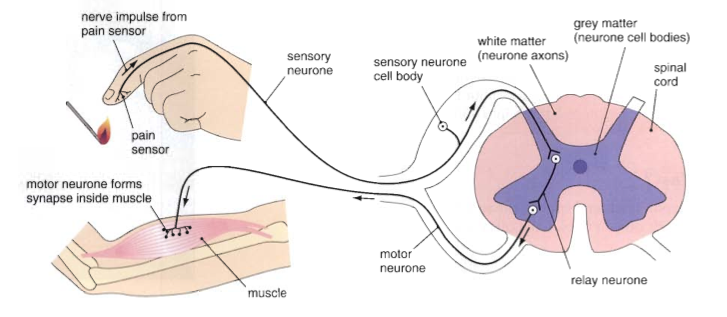
Describe the structure and functioning of a simple reflex arc illustrated by the withdrawal of a finger from a hot object
Reflex is the simplex type of response. It is very quick and is involuntary (automatically happen without you being able to consciously controlling it). Reflex reactions are often for self-protection, such as blinking, sneezing, or pulling your hand away from a hot object. 

stimulus --> receptor --> sensory neurone --> relay neurone in CNS --> motor neurone --> effector --> response

Impulse are usually passed from sensory nerves and remains in the spinal cord without going into the brain. The response is then processed in the spinal cord itself and then pass directly through the motor nerves to the effector (muslce) to bring about a response. It made the response much faster. 
Input produces the same output. This means it is a ‘fixed decision’ to bring about reflex. 
The small nerve called relay nerve in the spinal cord directly connects sensory nerve to the motor nerve so the response can take place. 
They know which relay nerve to target because it is encoded within our DNA.

For example, you touch something hot you will immediately pull your hand away from it --> this is reflex
The “OUCH” came AFTER the reflex and it decided by the brain (as part of the information goes into the brain as well) 
This happens after because reflex response is always faster. 

The reflex arc for touching hot object:

Stimulus (pain sensor responding to heat) --> sensory neuron --> spinal cord --> relay neuron --> motor neuron --> effector (muscles) --> response (pulling your hand away from the heat source)


2.84 How information is carried


Understand that stimulation of receptors in the sense organs sends electrical impulses along nerves into and out of the central nervous system, resulting in rapid responses

Sense organs are the receptors and send message along the sensory neurones to the CNS. 
Muscles and glands are effecters and receive messages the motor neurones from the CNS.
Relay neurons connect other neurones together. 
Neurones can be very long to pass information from one part of the body to another. 


Impulse, which are electric signals,  are passed from the receptor to the coordinator by sensory nerves to the spine and into the brain.
The brain will then generates information and brings about a response by sending information down the spine through motor nerves. It can be either voluntary or involuntary. 
Voluntary response always involve the brain. 
Involuntary response is called reflex, controlled by the spinal cord. 

The impulses are passed very quickly along the axon of the neurone. 
When nerves meet, they do not actually touch but form a gap called synapses. Impulses "jump" from one synapse to another. More specifically, chemicals are releases which pass across this gap by diffusion. They travel along one nerve after another.
Some axon has fatty sheath and protein around it which insulates the axon and therefore information can be carried along faster. 


2.83 Nervous system

2.83 Central Nervous System
Recall that the central nervous system consists of brain and spinal cord and is linked to sense organs by nerves

Nervous system controls our action and coordinates different parts of our body for movement and response, both voluntarily and involuntarily. 
The central nervous system includes brain and spinal cord, both made up of delicate tissues. Information and decision is processes and made in the CNS.
The peripheral nerves connects organs to the central nervous system. Each nerves is made up or nerve cels or neurones.
Signals are sent through the form of electro-chemical impulses.


Thursday, January 26, 2012

2.82 Communication


Describe how responses can be controlled by nervous or by hormonal communication and understand the differences between the two systems

1. Nervous system
The cell body of the nerve would be connected to the spine
The other end, synaptic knob, of the nerve would be connected to the effector, which is most likely a muscle
The electrical impulse, or nerve impulse, is carried along inside the nerve down the axon from the cell body to the synaptic knob, which can be a meter long (and it is a single cell).
In mammals, the axon can be surrounded by another kind of cell known as the schwann cell. It contains a great deal of fats and formed a myelin sheath, which helps increase the speed of nerve conduction (for information to be passed).

2. Hormone - Endocrine system
Hormones can be proteins or steroids.
Made in the endocrine glands
Travel in blood
Effect the target tissue

Endocrine gland produces chemical known as hormone. 
Eg) adrenal gland which produces adrenaline
The hormone is secreted into the blood and travels through the stream and arrive at target tissue/ organ that will have an effect on.
Hormones can have multiple target and brings about multiple effects.

Nerves transfer impulses much faster than hormone does.

The picture only shows a motor nerve. 

Sunday, January 22, 2012

2.77b) Thermoregulation


Controlling body temperature


Components of skin which controls body temperature

Sweat gland
Capillary network - allows blood to move closer of further away from the surface of the skin 

If the body temperature increases, the input to the hypothalamus stimulate responses in the skin which bring about cooling, such as sweating or the flow of blood to the surface of the skin increases. Blood vessel dilates and increase the exchange of heat to the outside of the body by processes such as sweat and vasodilation. This results in cooling of the blood.
- Sweating
- Vasodilation
- Hairs flat
--> decrease body temperature

In the cold environment, out body temperature will fall and hypothalamus brings about regulations in increase of body temperature
- Shivering
- Vasoconstriction
- Hairs raised
--> increase body temperature

Efficiency of the system responding to stimuli--> how far it deviates from the fixed point

Monday, January 16, 2012

2.77a) Thermoregulation


Understand that homeostasis is the maintenance of a constant internal environment and that body water content and body temperature are both examples of homeostasis

Homeostasis - Conditions are kept at the same or constant throughout
Homeothermic - Temperature are kept the same or constant
Organisms such as mammal keeps their body temperature constant despite changes in the temperature of the environment. These organisms are called homeothermic organisms. 

Mammals always keep their body temperature constant because enzymes have a point of temperature which is called optimum temperature (maximum) . They would try to keep their body temperature as close to the optimum temperature as possible. 


2.76) Sensitivity


Understand that organisms are able to respond to changes in their environment

Sensitivity - the characteristic in which organism respond to changes in their environment

Types of stimuli
- Light
- Temperature
- Pressure
- Chemical 

Receptor is needed to detect such changes in the environment
The response is produced by effectors which are muscles or glands. 
It is the response that ensures the organism is able to survive any changes in the environment.