Showing posts with label Food Production. Show all posts

Monday, February 20, 2012

5.9 Fish Farming


Explain the methods which are sued to farm large numbers of fish to provide a source of protein, including maintenance of water quality, control of intraspecific and interspecific predation, control of disease, removal of waste products, quality and frequency of feeding and the use of selective breeding 
Fish
- low fat and high protein
- efficient at turning their nutrients into fish mass

Advantage of fish farming
- allow us to control quality of water, ensuring that it's clean
- control predators
- reduce pests
- reduce disease
We contribute to the increase of yield of fish.

Disadvantage of fish farming
- When you have a high density of fish, the possibility is the transmission of disease. Because of this, some fish farmers have been using antibiotics, which is a concern to human health. 
- Abundance of fish also makes pest, so some farmers would use pesticides, which is also a cause of concern for human body.


Sunday, February 19, 2012

5.8 Fermenter


Interpret and label a diagram of an industrial fermenter and explain the need to provide suitable conditions in the fermenter, including aseptic precautions, nutrients, optimum temperature and pH, oxygenation and agitation, for the growth of microorganisms

The industrial fermenter is the reaction vessel in which fermentation occurs. It is usually built out of metal such as copper or steel. Inside the steel jacket there is usually another steel jacket inside, and in between it contains water which made up the cooling jacket. Once the fermentation gets going it produces heat, and this cools down the reaction to keep temperature at optimum temperature. 

The fermenter will need to be cleaned and that's why we have a tubelike inlet which allows the steam to be pass into the fermenter. The steam will be sterilizing fermenter between fermentations (after finish producing the product and we need to clean the tank out). 

Within the fermenter there will be a heating plate to raise the temperature, which is called heater. 
Heater + Fermenter ---> Keep at optimum condition 

For fermentation to occur, we have to put nutrient into the tank, so there is a tap or pipework to insert nutrient as foods for microorganism.

To measure the internal temperature there is a temperature probe in the fermenter and it will tell us whether to apply the heater or the cooling jacket. 

The reaction will also require the addition of microorganism (so we have another tap for that). Reaction occurs inside the tank. 

We also require a pH probe as we are trying to keep the pH level at the optimum rate. 

We are also going to need a way to stir the reaction. This is going to be done by having a motor inside the fermenter and this will agitate the mixture, stopping it from clamming together and spreading the microorganism throughout the mixture.

At the end of reaction, we will need a way to drain off the product. This is called downstream processing which involves purification 

Overall, the fermenter is to keep the optimum growth conditions for the microorganisms so it is able to produce the product that we are looking for. 


Saturday, February 18, 2012

5.7 Yoghurt

Understand the role of bacteria (Lactobacillus) in the production of yoghurt

1. Cow produces milk through the process of milk production. 
2. Milk goes through process called pasteurization to remove pathogens such as TB bacillus. This heat treatment kills off any pathogens in the milk. 
3. Milk sugars are converted into lactic acid. This is brought about by incubating the milk by 45-46 Celsius and add lactobacillus, which produces the enzyme that breaks down the milk sugar lactose to produce lactic acid.
4. Lactic acid results in lower pH, creating acidic condition. This causes milk proteins.
5. Milk proteins will solidify. This solidification of milk product produces what we called yoghurt

5.5 Beer Production


Understand the role of yeast in the production of beer


Beer-- composed largely ethanol, which is a kind of alcohol
Glucose --Yeast/Enzyme--> Ethanol + Carbon Dioxide 
This reaction is in the form of anaerobic respiration which is carried out by yeast, which is a kind of microorganism able to supply the enzyme, to bring about this convert ion.

Ethanol is often flavored by the addition of plants such as hops

Glucose comes from starch in a two step process: 
1. Starch -----> Maltose 
Enzyme: amylase
Source: Barley seeds, wheat seed, rice
Starch is broken down through amylase through the germination of the seed, which is the stage called malting. 

2. Maltose -----> Glucose
Enzyme: Maltase


Wednesday, February 15, 2012

5.4 Pesticide and Biological Control


5.4 Pesticides and Biological Control 
Understand the reasons for pest control and the advantages and disadvantages of using pesticides and biological control with drop plants

Where we have large field of crop all with the same type (monoculture), they tend to be very susceptible to pests, which use crop as their food sources.
This will reduce the productivity of farming ---> loss of food & financial impact 

To overcome this farmers can use…

1. Pesticides - chemicals designed to kill the pests
Advantages
- Chemicals = easy to obtain
- Easy to apply 
- Very effective
Disadvantages
- Toxic = killing other plants and animals other than the pests, and may be harmful to humans
- Bioaccumulation = pesticides buildup through the food chain causing problems for animals in the higher trophic level. Eg DDT
- Mutation in the pests often leads to resistance = pesticides have to be applied in higher concentration --> more toxic/ no longer work --> we have to find alternative pesticides 


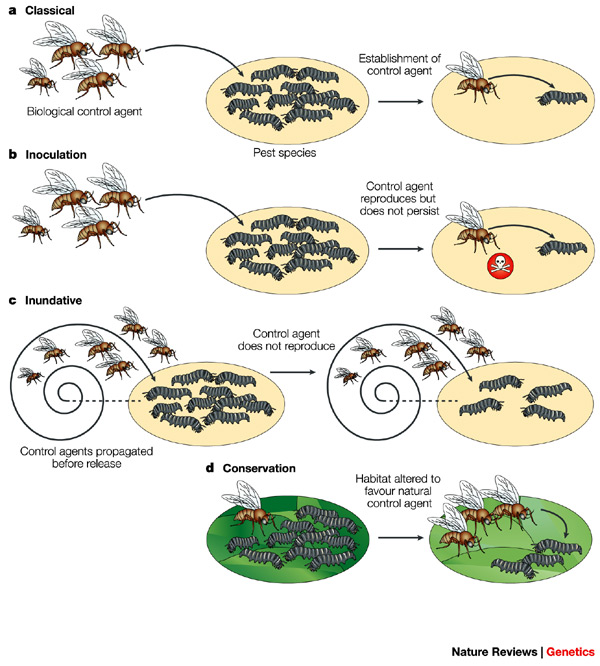
2. Biological Control

For example..
In Australia, Cactus A of North America was introduced to gardens, and escaped into the country side and flourishes under Australian climate and ecosystem. The cactus then starts to cover a good deal of agricultural land and it was necessary to get rid of this. 
However, there were no natural predators of such cactus in Australia, so it was necessary to introduce alien species from another country, which was a moth/larvae, which feeds on the cactus (Cactoblastis). It has no competitors and was able to eat away this cactus and remove it from the agriculture land of Australia.
This control of pests by herbivore is called biological control

Advantages:
- No toxic/ chemicals involved
- Less impact on man and wildlife

Disadvantages: 
- Not 100% effective
- Difficult to control = always a danger that introduced species will find alternative prey on which to feed and will not actually die out once the pest has been removed

- Difficult to math a predator to the prey (to remove your pest)

Saturday, February 11, 2012

5.3 Fertilisers


Understand the use of fertilizers to increase crop yield

We can increase the growth of plants in farming by the application of fertilizers to the soil. Fertilisers are usually in the form of nitrate and phosphate, or combination of both.
These compounds go down into the soil and are taken up from the root structure, and move in the transpiration stream up to the leave.
Nitrate --> proteins
Phosphate --> DNA, membrane structure 

Fertilisers can be divided into two groups. 
1. Organic fertilizers
Produced from animal waste on farm
This usually take the forms like Cow faeces, collected by the farmer
It often goes through the process of decomposition and fermentation and form a substance known as slurry. 
This gives crop plant a supply of nitrate and phosphate to promote growth. 
2. Artificial fertilizers 
Take the forms of chemicals 
- Potassium nitrate
- Ammonium nitrate
Apply to the field, they will go into solution in the soil water. This will release nitrate and promote growth in the same way as it would do at the compound. 

5.2 Crop Yield


Understand the effects on crop yield of increased carbon dioxide and increased temperature in glasshouses


Rate of photosynthesis:
CO2 + H2O ----light/enzyme---> C6H12O6 + 6O2

1. Increasing concentration of carbon dioxide
Carbon dioxide is the substrate. 
If we increase the concentration of substrate, the rate of reaction will increase and become constant at one point. 
This means we will have a higher yield up to a point when we reach the optimum carbon dioxide level. That point will give you the highest yield of product. 


2. Increasing temperature
The higher the temperature, the greater the kinetic energy. This means that particles collide into each other more frequently, resulting in higher chance for them to collide in correct orientation with greater temperature --> higher rate of reaction. 
However, a temperature which is too high can also do denature the enzyme and therefore slow down the rate of reaction. 
The peak of the graph is the optimum temperature


Increasing temperature also have other effect such as avoiding frost damage and providing constant temperature. 

If we increase the temperature and carbon dioxide, we will increase the rate of photosynthesis, and therefore yield. But they all have limit.

Wednesday, February 8, 2012

5.1 Glasshouses


Describe how glasshouses and polythene tunnels can be used to increase the yield of certain crops 

Both polythene tunnel and greenhouse provide warmth for the growth of plant. 

The glasshouse (or greenhouse) is constructed on a framework of a simple house structure.
All surfaces are glass, allowing the light to penetrate through to the interior.
How it works
1. Solar radiation, which is initial source of energy, in the form of light
2. Light penetrates through the glass into the internal surfaces
3. Light is absorbed by surfaces inside the glasshouse, which can be soil, wooden surfaces, and plants themselves
4. These surfaces then reemit this energy as heat
5. The heat warms the air, raising its average kinetic energy = temperature increases
6. The warm air which is raising the temperature is trapped and create convection current within the glasshouse

This cause the increase of crop yield because…
How it works: Warm air in glasshouse ---> Increase in crop yield 
1. The higher temperature leads to closer, or optimum temperature, for enzyme reaction such as photosynthesis. (enzymes work most efficiently, allowing the fastest rate of reaction)
2. Allows constant temperature throughout the year = constant production (especially high altitude area) 
3. Prevention of loss of water vapor (they have a constant supply of water) 
4. Avoid frost damage to seedlings (in the spring time) Polythene tunnels are usually used to protect growth of seedlings in spring time, and removed to allow full growth in summer 
5. Glasshouses are often warmed by the burning of fossil fuels
= increase carbon dioxide level (increase concentration of substrate for photosynthesis) --> more product and growth
= inefficient burning of fossil fuels lead to the production of ethene gas, which turns out to stimulate fruit ripening (especially tomato) 


The polythene tunnels has polythene as surface on its framework and again allows light to penetrate to the interior.
This is used in less developed country as it is cheaper.
Advantage: more adjustable and movable
Disadvantage: less shelter for plant; less effective (which may decrease total output)