Friday, October 7, 2011

3.31) Evolution


Describe the process of evolution by means of natural selection

Evolution
- change in form of organisms (new forms arising)
- change in frequency (how many) of alleles
Natural Selection 
- the mechanism of evolution (first proposed by Charles Darwin)
Example:
a bacteria staphlococcus aureus which can lead to skin and lung infection
The original form of such bacteria is sustained to be kill by methecilline, which is a type of antibiotic. (They are susceptible to the antibiotic.) MSSA
What happened is that a random mutation to the genome of the bacteria allowed us a characteristic of 'breaking down methecilline.' This means that it is no longer killed by the antibiotic. This new form is called the Resistant form, MRSA.
[Refer to definition number 1 of evolution]
Because the MRSA is resistant to the antibiotic, they became increasingly common (increase in frequency of the allele) 
[Refer to definition number 2 of evolution]

Two features of natural selection (process):
1. Random mutation - produce MRSA form 
2. Non-random selection - due to anti-biotic which is selecting the MRSA to survive and MSSA to be selected and killed


3.30) Mutation


Recall that mutation is a rare, random change in genetic material that can be inherited
In every DNA, there is what we called the base sequence, which cause the gene. The form of the gene is called allele. Certain process or event can result in a change of the base sequence. For example, for ACT to AAT. 
This change creates a new version of the alleles. It's possible that this allele can create an entire new protein, and have an entire different affect on the phenotype. 
Consider the dominant and recessive alleles: A and a. The reason why different alleles exist is because of the process called mutation, that changes the base sequence of the gene. 

3.29) Species Variation


3.29) Species Variation
Understand that variation within a species can be genetic, environmental, or a combination of both
Variation = differences in phenotype, by counting or measure the differences and show them in bracket form
Everyone individual has a phenotype. The phenotype is determined by the difference in genotype and environment. (continuous variation)
Different classes suggests that the variation in the species is entirely due to the variation in the genotype, with no role for the environment to play. 
For example, blood group. A, AB, B, O

Variation in the genotype can also be modified by the environment. (You can see as continuous variation) 
For example, one might inherited the genotype for being tall, but the environment such as diet also affect his height. 

Variation in population/ species that's entirely due to environmental variation. Genes have no role here. This cannot be inherited, so therefore the variation is not continuous. 
e.g.) a particular home language that you speak 


Saturday, October 1, 2011

3.20) Pedigree Diagram


Understand how to interpret family pedigrees

Square - Male
Circle - Female
Filled in shapes - Inherited Condition (they are often diseases but NOT necessarily) 
These are represented by phenotype. 


Pedigree can be use to interpret that the affected condition is caused by dominant or recessive allele. 

3.21) Genetic Probability


Predict probabilities of outcomes from monohybrid crosses

Monohybrid - a hybrid that is heterozygous with respect to a specified gene

Generation 1:
Red (RR) x White (rr)
Red is dominant to white. 
---> Meiosis
The alleles are being separated. The gamete would contain one one of the two alleles with equal chance. 
Which means the gametes of red petals will be separated into (1/2)R and (1/2)R. The white petals would be (1/2) r and (1/2) r.
We then considered random fertilization by drawing table to illustrate to possible phenotypes and genotypes of the offsprings through Punnett square (Mendel's diagram). 


In this example, the genotype would all be Rr.
So the phenotype would ALL be red. 
So the probability would be 100% that you would have a red offspring. 


Generation 2:
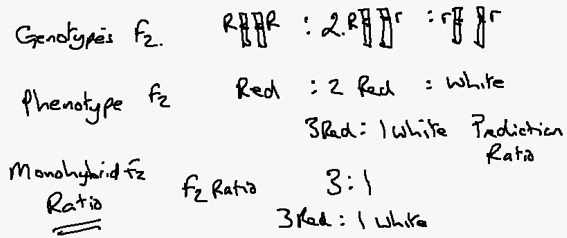
Now we try to cross heterozygous parents (Rr) and (Rr)

We have…
25% of RR
50% of Rr
25% of rr
Genotype ratio…
RR:Rr:rr = 1:2:1
Phenotype ratio…
Red:White - 3:1
They are chances and probability. It depends on which pollen grain fertilizes with which ovule. 

3.18) c. Codominance


Recall the meaning of the terms: dominant, recessive, homozygous, phenotype, genotype and codominance.

Codominance refers to a relationship between two alleles of a gene in which both phenotypes of the genes are visible and do not over power each other in phenotype. This happens when both alleles are dominant. 
The offspring will result in an unusual third phenotype as the parents both contribute to the phenotype. The offspring's genotype would be a heterozygous of both dominant alleles. 


Friday, September 23, 2011

3.19 b) F1 x F1 Cross


3.19) Describe pattern of monohybrid inheritance using a genetic diagram
F1 = First Generation